Tamenglong College, a co-educational institute, was established in the year 1986. On 28 September 1992, the College was given provisional affiliation to Manipur University. On the 28 August 1995, the College was taken over by the Government of Manipur as a full-fledged Government College. On the 1st December 1999, the College got permanent affiliation status to Manipur University and on 5 September 2000, the University Grants Commission included Tamenglong College into 2F & 12B of the UGC Act, 1956. Since then, the College has been serving the society as the sole provider of higher education in the district. Presently, the College offers under-graduate courses in Arts and Science.
The leaders of different tribes of Tamenglong district felt the need for higher education institution in the district head quarter. They convened a public meeting and resolved to establish a College. It was on Thursday, 9 July 1979 at Tamenglong Bazaar Shed, a decision was taken for the establishment of a college in the district headquarter. Thus, the picture of a higher education institution emerged in the district. A governing body was formed and a college called “Tamenglong College” was established and it functioned for a period of 2 years. After a period of 5 years discontinuation, a new governing body was formed in 1985. A formal DPC was conducted for the recruitment of teaching and ministerial staff on 24-07-1986. A remarkable event of that time was the decision taken by Manipur Legislative Assembly in its winter session in 1990. The decision was “The government of Manipur resolved to establish one Governmental Degree college in every district headquarter”. The people’s representatives, public leaders of the district and the Governing Body of Tamenglong College endeavoured to fructify the decision of the Government of Manipur. The relentless efforts resulted in granting of affiliation by the Authority of Manipur University in 1992 to Tamenglong College. Honourable Chief Minister, Shri Rishang Keising inaugurated the conversion of the College into a full-fledged governmental degree College on the 28 August 1995. Then on, Tamenglong College started functioning as a full-fledged Governmental Degree College at Duigailong/Dimthanlong, Tamenglong III, Tamenglong-795141.
Located in one of the remotest districts of India, Tamenglong District is 147 Kms away from the state Capital, Imphal. The College is located at Dimthanlong, Ward No.3, Tamenglong District, Manipur-795141. In spite of so many challenges arising from geographical location, irregular electricity and transport problems, and bad internet connectivity, the College gives affordable and quality education to all sections of the society especially Tribal communities. So far, this lone College of the district has produced notable number of leaders, intellectuals and officers.
At present, there are 26 faculty members (including the Principal) out of whom five are Ph.D degree holders, 4 M.Phil, and 17 others with MA/M.Sc with UGC-NET/JRF. There are also 10 non-teaching staff including the Librarian.
The College is an Arts’ Degree College with 9 Disciplines offering General and Honours degree – viz. English (Hons), Economics (Hons), Education (Hons), History (Hons), Political Science (Hons) and Sociology (Hons). The pass percentage of students is around 87 % (taking into account the aggregate pass percentage of last five academic years examinations’ results).The College has a well-equipped Library with regularly updated latest books including students’ Text Books for those students who cannot afford to buy text books. To develop a sense of closeness and team spirit which is an essential part of education, the College conducts annual sports meet every year where various outdoor and indoor games like Football, Volleyball, Badminton, Table Tennis and Carom, etc. are played. The College holds seminars, talks, and various other co-curricular activities like cultural programmes, literary meet, Alumni Meet, Freshers’ Meet, etc. to encourage the spirit of competition in students and foster good relationship among teachers, students and other stakeholders of the College. The College has a large and spacious multi-purpose hall with IT facilities where seminars, talks and examinations are held. Each classroom has a white board and markers with enough benches and desks to cater around 40-50 students. Each classroom is electrified with ceiling fan and facility for Power Point Presentation.
Vocational Course in Horticulture was opened in the College under the programme ‘Vocationalisation of Higher Education in Manipur’ in the year, 2017. The vocational education is under Rashtriya Uchchatar Shiksha Abhiyan (RUSA), Government of India. The course is being looked after by Industrial Partner SYNAPX, Imphal. Around 10 students were enrolled in vocational course in the session, 207-18 and 25 students were enrolled for the year 2018-19.
The College has an active NSS Unit, led by a Program Officer. The program aims at developing students’ personality through community service. The NSS team of the College has organised District Youth Parliament where youths of the District participated in speech competition for attractive prizes in 2018. College level symposium too was organised by the College NSS Unit in 2018. Also, the team conducted various community services including-Clean India Campaign, public urinal cleaning campaign, drain cleaning, street cleaning, construction of widowed household toilets and campus social service.
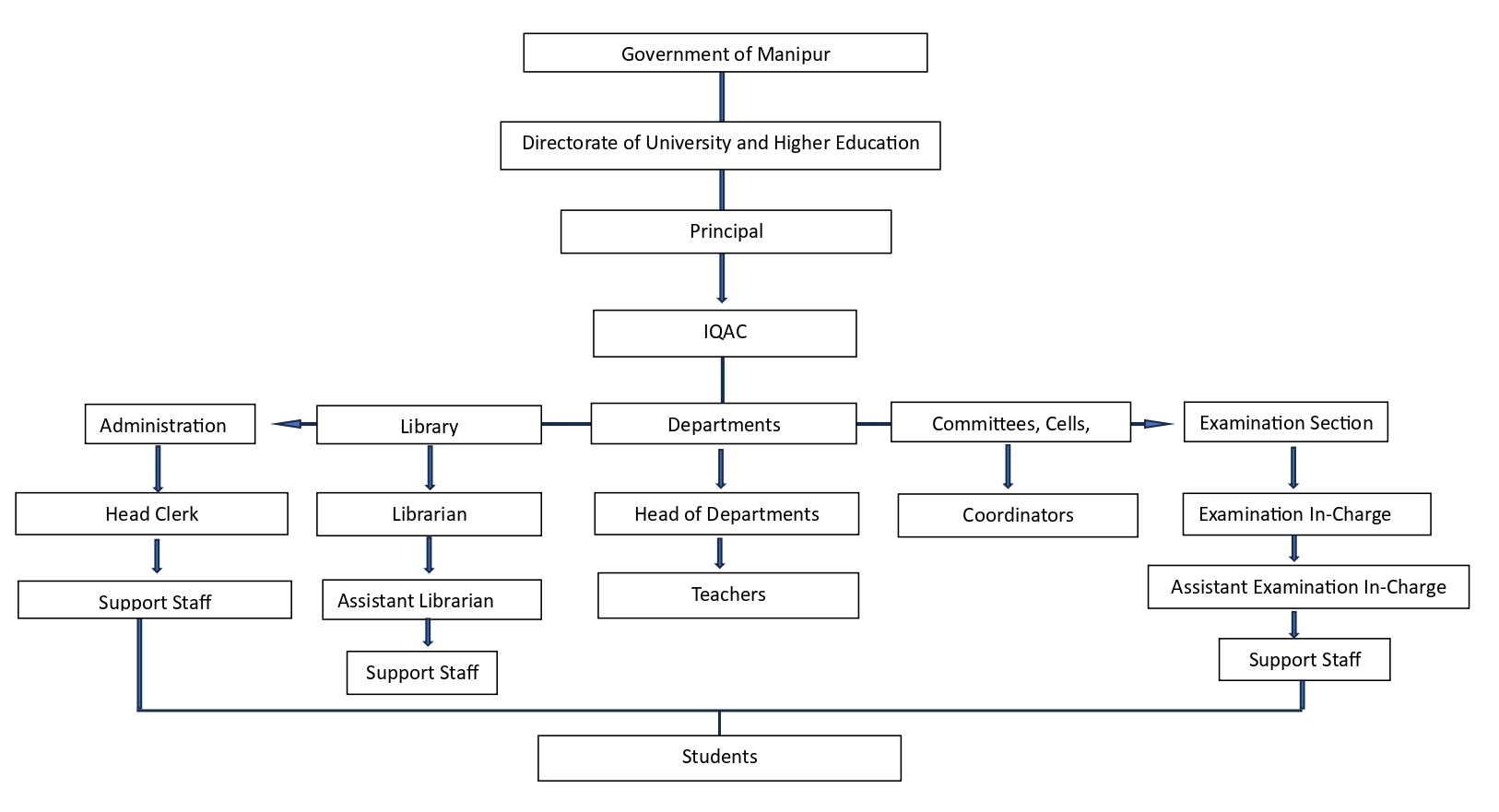
The College has its IQAC cell with the Principal as the Head which plans, institute and supervise to increase quality, to ensure timely, efficient and progressive performance of Academic , administrative and financial tasks. The Students Grievance Redressal Cell of the College promotes cordial students-students and student-teachers relationship by encouraging students to express their grievances/ problems freely without fear of victimisation. Various other cells like, Environmental Awareness Cell, Career Counselling Cell, Soft Skill Development Cell, Alumni Association etc. are formed for the smooth functioning of all academic and co-curricular activities.
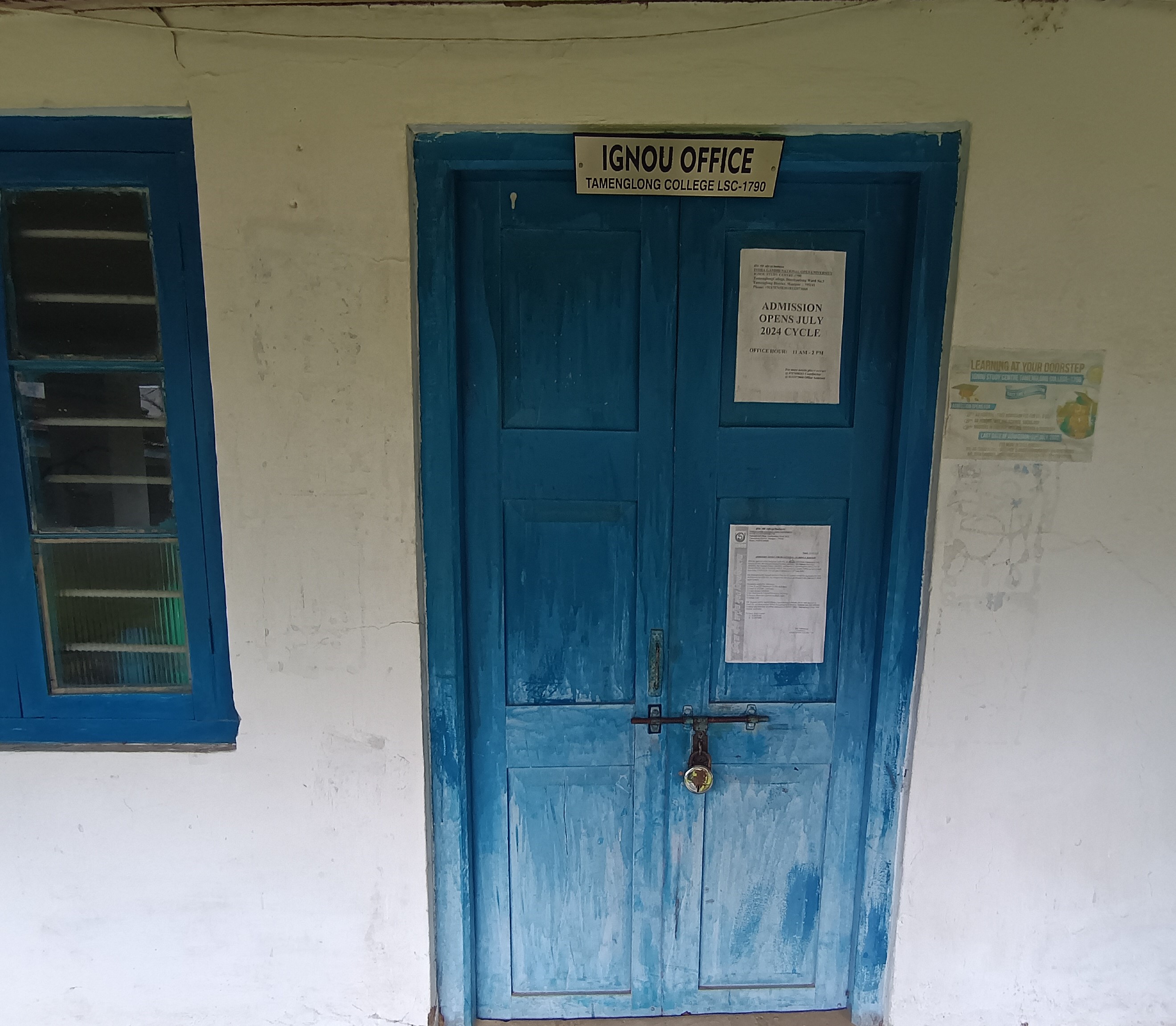
The College IGNOU Study centre-1790 offers BA General, BA Honours in Political Science, Sociology, History and Masters of Arts in English, History, Sociology, and Political Science starting from 2022.
The Unnat Bharat Abhiyan (UBA) Cell of Tamenglong College conducts Awareness Programs to 5 adopted villages on various topics ranging from cleanliness, hygiene to safe drinking water, etc. so as to achieve the mission of UBA, MHRD, Govt of India in transforming lives of the remote villages and bringing sustainable development to the adopted villages.
The College aims to bring about a transformed change of Higher Education in Tamenglong District in particular and the nation in general producing the best of Nation’s Intellectuals, Scholars, Writers, Officers and Social Leaders by catering to the needs of students, understanding their feedback, letting them achieve perfection in every field with strict adherence to ethical and moral principles; and also updating and upgrading with latest ICT facilities in teaching and learning process so as to make learning outcomes at par with those in best institutes of the country. The College observes all National and State Holidays in full spirit. National important days like Independence Day, Republic Day, Gandhi Jayanti and others are observed with full enthusiasm from teachers and students.
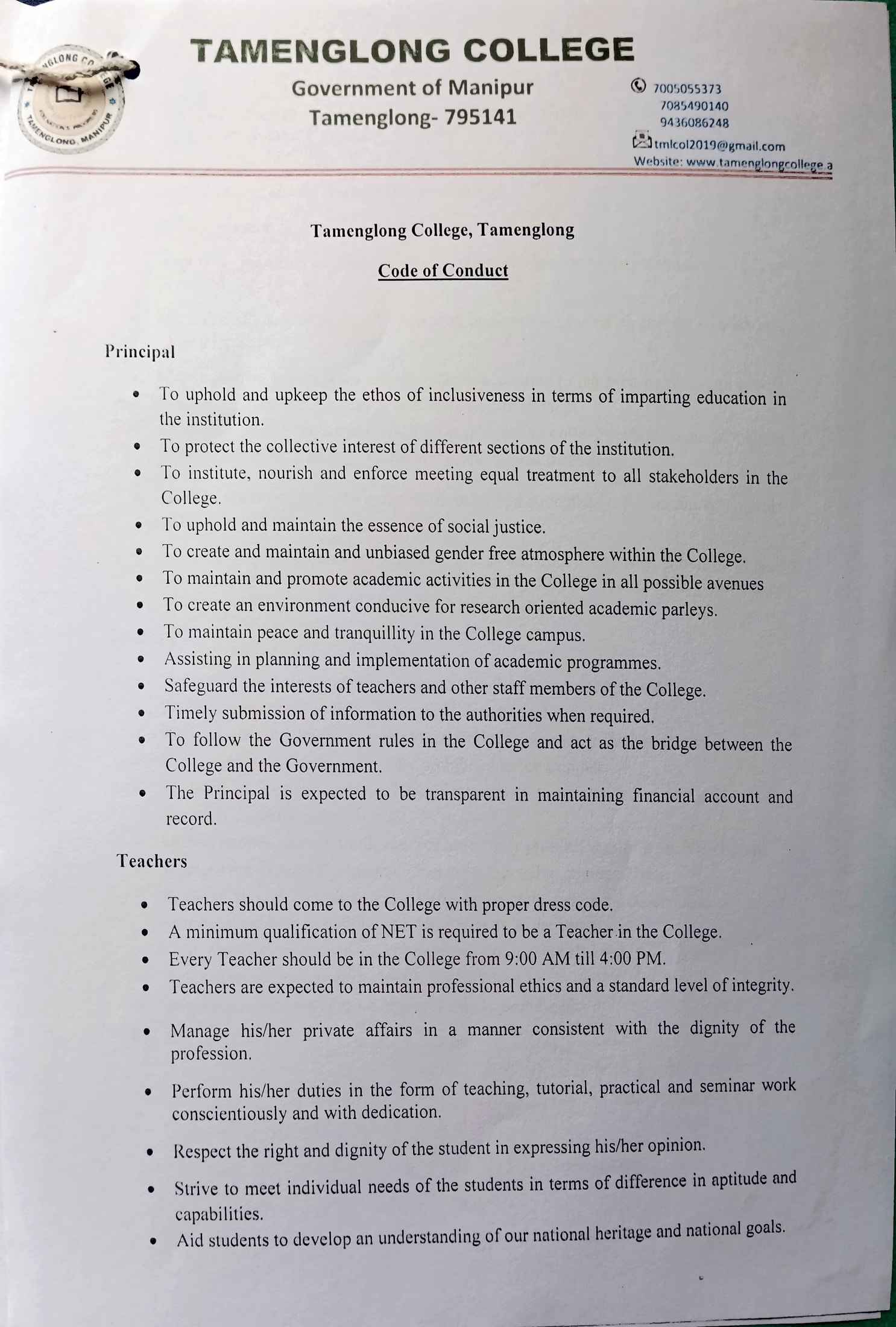
Attendance Tracking System: Attendance tracking is one of the vital practices followed in the college. Every month the attendance of each student is tracked and monitored. At the end of the month the percentage of students’ attendance is calculated and the same is submitted to the office of the IQAC. It is then compiled and displayed on the notice board for the students to see and improve upon their attendance. Students with low attendance are strictly informed to be regular. Every student is required to attain 75% of attendance to be qualified to sit for the semester end examination conducted by the university.
At the start of every academic session, syllabus is given out to the students and they are oriented on the content of the various papers. The class routine is prepared by the IQAC for the various departments and each department has their own. These systems are followed for effective teaching-learning and evaluation of the students.
">Tamenglong is one of the Districts of Manipur State in India. Tamenglong College is the only NAAC-Accredited College in Tamenglong District. It has both Arts and Science Streams. I have been in this College since its inception in 1986. On the 6th of January, 2024, by the providence of God, I occupied the chair as the Principal of Tamenglong College.
Tamenglong has a congenial climate for education. Tamenglong College has strong faculty members and it also serves various facilities and co-curricular activities for the students. It envisioned empowering the students; development and lifelong excellence with the mission to provide affordable quality and holistic education.
As the principal of Tamenglong College, I invite all the aspiring students to come and venture along the path of educational excellence at Tamenglong College. I also welcome suggestions and help from all the stakeholders to uplift the standard of Tamenglong College and the younger generations as well.
Dr. Kinthuijinang Maremmei,
Principal,
Tamenglong College